
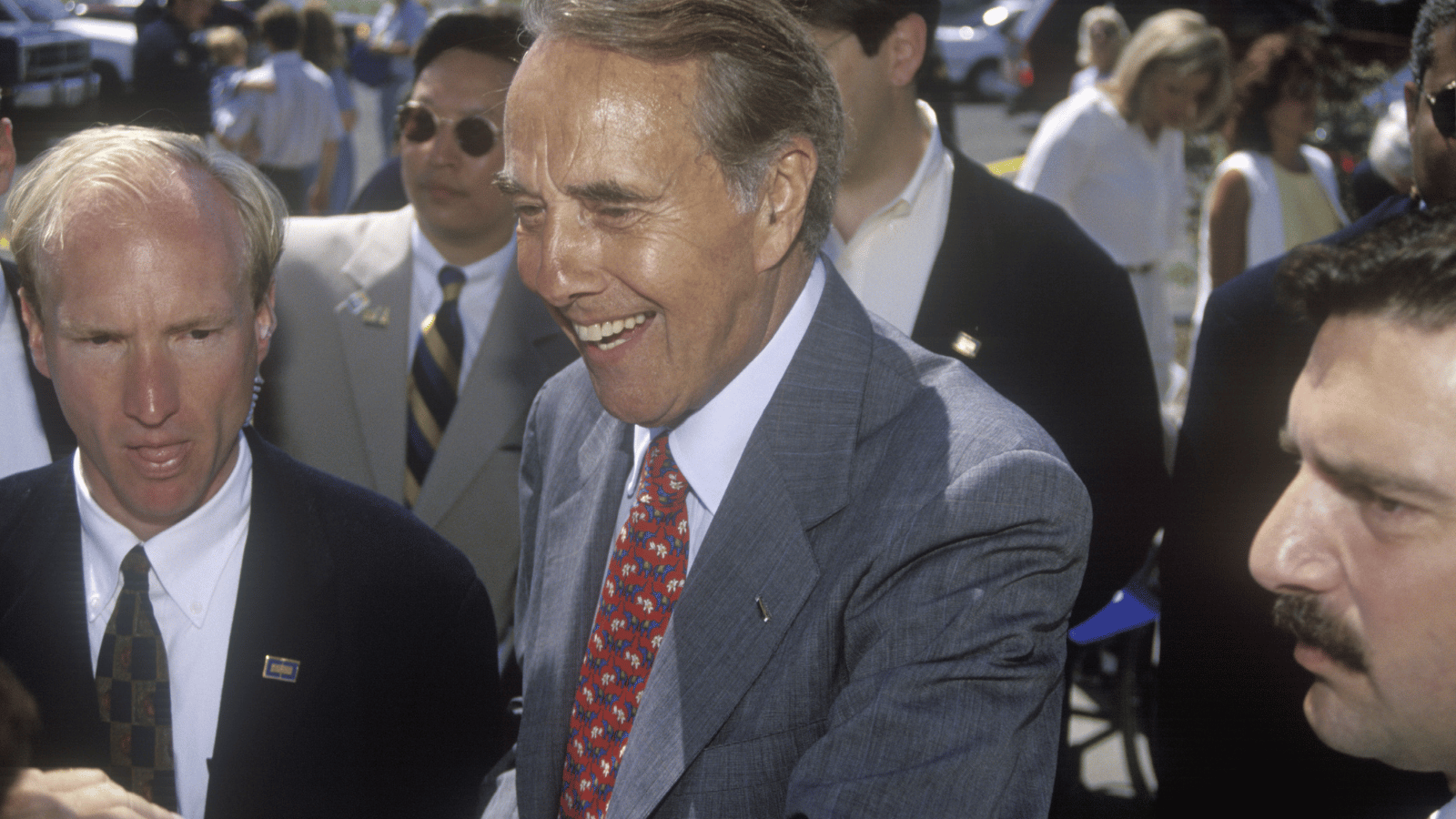
There are some health conversations people avoid until someone respected says the quiet part out loud.
That is what Bob Dole did.
To many Americans, Bob Dole was not just another politician. He was a decorated World War II veteran, a longtime U.S. senator from Kansas, a former Senate Majority Leader, and the Republican presidential nominee in 1996. He had lived a public life built on service, discipline, toughness, and resilience.
So when a man like that began talking publicly about erectile dysfunction, people paid attention.
Not because the subject was easy.
But because it was not.
A Private Struggle Behind a Very Public Life

In December 1991, Bob Dole was diagnosed with prostate cancer. He underwent surgery to remove his prostate, and the operation was considered successful.
But the surgery left him with a side effect many men experience after prostate cancer treatment: erectile dysfunction.
That is the kind of thing many men never talk about.
Not with friends.
Not with family.
Sometimes, not even with their doctors.
And honestly, it is easy to understand why. For generations, erectile dysfunction was wrapped in shame. It was often called “impotence,” a word that sounded less like a medical condition and more like an insult. Men were expected to be strong, ready, and silent. If something changed in the bedroom, many carried it quietly.
Dole could have done the same.
By 1996, he was running for president against Bill Clinton. He was 73 years old, one of the most visible men in America, and his health history was already part of the public record. But even then, bedroom health was not something major political figures discussed openly.
Then Viagra entered the picture.
The TV Moment That Changed the Conversation
On March 27, 1998, the FDA approved Viagra, developed by Pfizer, as the first oral medication for erectile dysfunction. Almost immediately, it became a cultural phenomenon.
In its first week of sales, more than 36,000 prescriptions were written. Within the first few months, millions of prescriptions had been filled. Viagra was not just a new drug. It was a national conversation.
Then, in May 1998, just weeks after the approval, Bob Dole appeared on CNN’s Larry King Live and admitted he had participated in Viagra’s clinical trials.
He even called it “a great drug”
That moment mattered.
Here was a former presidential candidate, a war hero, and a respected elder statesman saying, in public, that erectile dysfunction was real, personal, and worth discussing. He was not making crude jokes. He was not hiding behind vague language. He was talking about a health issue that millions of men and couples understood but rarely named.
By December 1998, Pfizer officially hired Dole as a spokesperson for Viagra.
In one of the original commercials, he said, “It’s a little embarrassing to talk about erectile dysfunction. But it’s so important to millions of men and their partners.”
That line was simple, but powerful.
It did two things at once.
First, it admitted the awkwardness. Yes, this can feel embarrassing.
Second, it made the issue bigger than one man’s pride. It was important to men and their partners. That wording mattered because erectile dysfunction does not happen in isolation. It can affect confidence, communication, relationships, emotional closeness, and how people feel inside their bodies.
Dole helped make the conversation feel respectable, clinical, and human.
Why Bob Dole’s Honesty Still Matters

The numbers show why this conversation needed to happen.
The landmark Massachusetts Male Aging Study found that 52% of men aged 40 to 70 experienced some degree of erectile dysfunction. Harvard Health has estimated that erectile dysfunction affects as many as 30 million American men. A major U.S. analysis using 2001–2002 national health data estimated that 18.4% of men aged 20 and older were affected.
More recent data also shows the issue has not gone away. A 2021 national survey found that 24.2% of U.S. men met criteria for erectile dysfunction, with prevalence rising sharply with age.
But here is the part that matters even more: erectile dysfunction is not always just a bedroom issue.
Sometimes it can be connected to blood flow. Sometimes to diabetes. Sometimes to high blood pressure. Sometimes cardiovascular health, stress, medications, hormone changes, sleep problems, or mental pressure.
In other words, the body may be saying something that deserves attention.
That is why Bob Dole’s public honesty was bigger than a commercial. He helped men see that asking for help was not a weakness. It was wisdom.
And that lesson still applies today.
At Uncle Jo, we believe vitality should be discussed without shame, fear, or awkward silence. Not because every intimate-health issue has the same solution, and definitely not because every conversation should lead to a pill. But because people deserve to understand their bodies better.
For men, vitality challenges may show up as performance pressure, low stamina, low confidence, or quiet frustration.
For women, they may show up differently: low desire, low energy, mood changes, dryness, stress, or feeling disconnected from the body.
Different experiences. Same bigger truth.
The body is connected.
Blood flow matters. Energy matters. Stress matters. Sleep matters. Confidence matters. Communication matters. And when something feels off, it deserves curiosity instead of shame.
Bob Dole’s story remains powerful because he did something many strong people struggle to do: he spoke honestly about a vulnerable part of life.
He reminded men that they were not alone.
He reminded partners that the conversation belongs to them too.
And he reminded all of us that real confidence is not pretending everything is fine.
Sometimes, real confidence is saying, “Something is going on, and it deserves attention.”
That is the kind of grown-up vitality conversation we believe in.
Warm. Honest. Human.
Because feeling alive in your body should never be something people are too ashamed to talk about.