
The stiff knees, the lost strength, the tiredness you have started to accept as your age. A lot of it is not age at all. It is disuse, and disuse runs backward.
You know the moment. You get up off the floor and you make a noise you did not used to make. You carry the groceries in one trip to prove a point and your forearms file a complaint. You tell yourself, well, that is what 50 feels like. And you file the whole thing under getting old, which is another way of saying there is nothing to be done.
Here is what the research says loudly and the fitness industry says quietly. Most of that is not your age. It is your mileage, and mileage can be rebuilt.
What is actually happening to your body
Your muscle peaks in your early thirties. After that, if you do nothing about it, you lose somewhere between 3 and 8 percent of it every decade, and after 50 your strength slides by 1 to 2 percent a year. Read that and it sounds like a life sentence handed down by the calendar.
It is not, and here is the part that changes everything. The biggest driver of that loss is not your birthdays. It is disuse. Your leg muscles start measurably shrinking within about 10 days of bed rest. Ten days. That is how fast the body sheds whatever you stop asking it to do. Which sounds like bad news until you flip it over. Anything that fades that fast from neglect comes back just as fast from use. Your genetics load the gun, but your daily life pulls the trigger.
The study that should end the excuse
In 1990, researchers led by Maria Fiatarone did something that should be printed on the wall of every gym. They took frail nursing-home residents with an average age of 90, and put them through eight weeks of proper strength training.
Their strength went up by an average of 174 percent. Their muscles physically grew. Their walking speed improved by 48 percent, and a couple of them set their canes aside. At ninety years old, in eight weeks.
Sit with that. If a frail 90-year-old can nearly triple their strength in two months, the quiet story you tell yourself at 48 about being past it does not survive five minutes with the evidence. You are not too old. You have never been too old. Almost nobody is.
Strength is not vanity. It is a survival stat.

This is not about looking good with your shirt off. Strength turns out to be one of the clearest signals of how long and how well you will live. In one of the largest studies ever run on it, every 5 kilogram drop in grip strength came with roughly a 16 percent higher risk of dying from any cause. On the other side, getting around an hour a week of strength work is linked to about 27 percent lower risk. Your muscle is not decoration. It is armor, and it is medicine.
The reframe
So when your body feels older than your license, resist the urge to file it under aging and give up. File it under deconditioned instead, because deconditioned is a status, not a sentence. You are not broken and you are not finished. You are under-used, and under-used is the most fixable condition there is.
Where to start
You do not need a gym that eats your evenings or a program with a logbook. Pick up heavy things a couple of times a week. Walk more than you do now. Eat enough protein to give your body a reason to keep the muscle it has. And start almost comically small, so it survives a busy week instead of dying in one. The point is not to train like you are 25. The point is to stop sending your body the signal that it is done.
And if you want to know which part of your vitality is draining fastest, so you aim your energy where it will pay off most, the free 2-minute Vitality Drain Quiz will tell you.
You are not out of the game. You just stopped playing.
Find your Mojo.
Uncle Jo
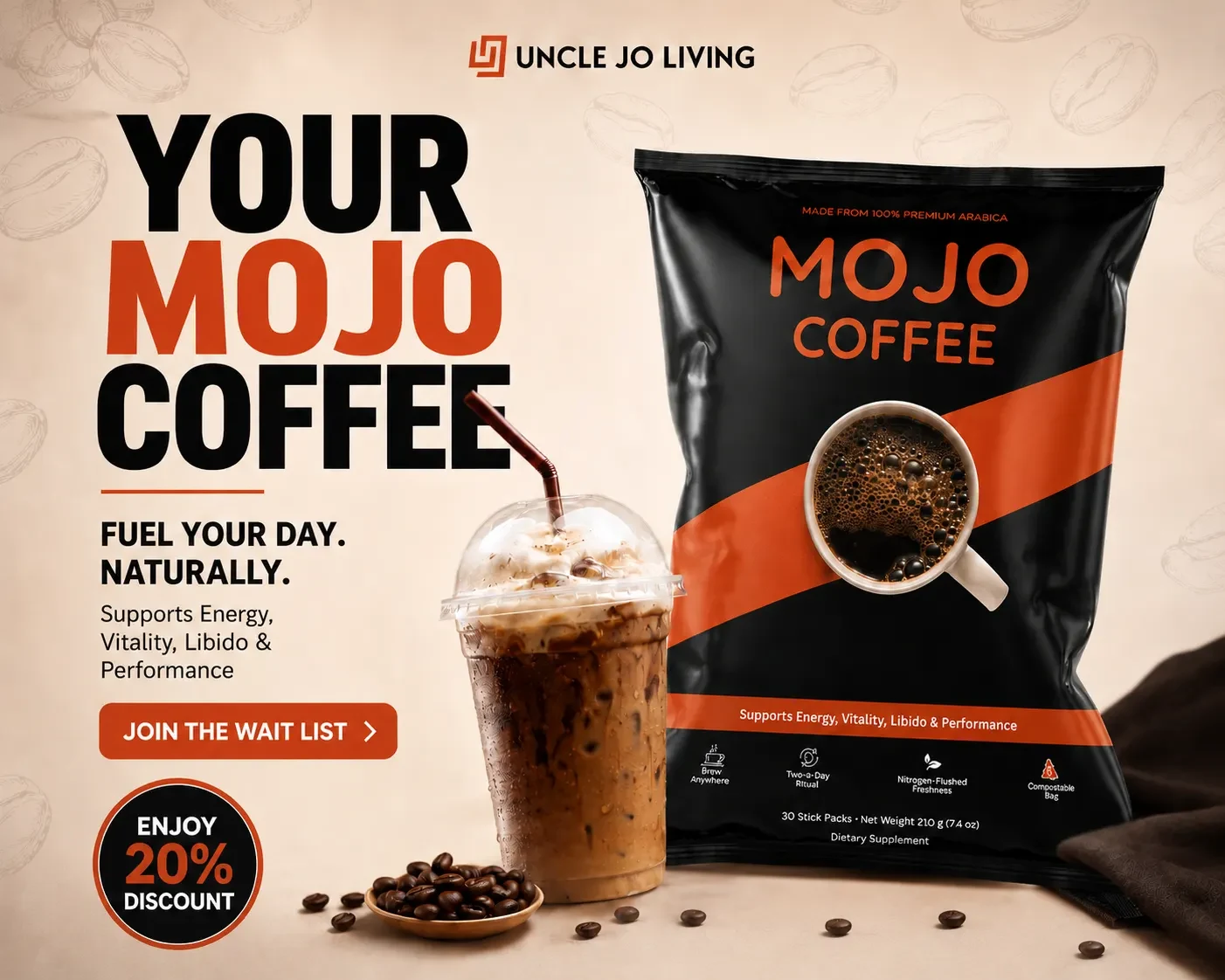
P.S. The work is yours, and nothing in a cup can do your training for you. But botanicals like Panax ginseng and ashwagandha are traditionally used to support stamina, steady energy, and recovery, which is part of the thinking behind MOJO. More on that another day. These statements have not been evaluated by the FDA. This product is not intended to diagnose, treat, cure, or prevent any disease.